My input:
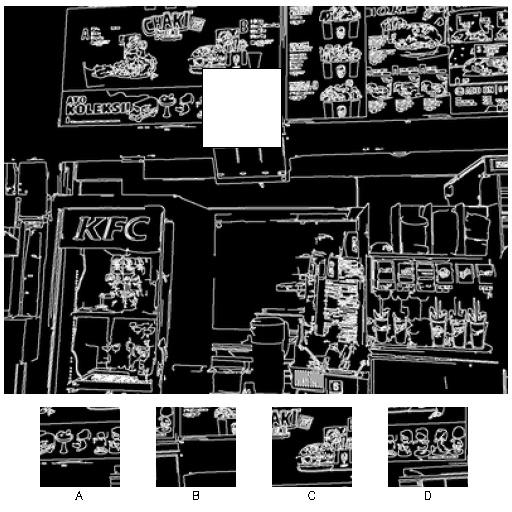
You are presented with a main image in which a square region is blanked out (occluded). Below the image are four candidate patches labeled A, B, C, and D, arranged horizontally from left to right. Exactly one patch correctly restores the missing region of the main image. Task: 1. The image shows edges and outlines only — color, shading, and texture have been removed. Focus instead on geometric structure, including lines, curves, corners, and junctions around the blank region. 2. Compare the direction, spacing, and continuation of contours between the main image and each candidate patch to determine which one best extends the existing edges. 3. Select the patch that maintains continuous line flow and spatial alignment, maintaining overall continuity and coherence within the scene.
Response:
Let’s look closely — I enlarged the blank region and each candidate so we can compare contour continuity.
Blank region (from main image):
Now the four candidates, each shown with the immediate surroundings above it for context:
-
Patch A
-
Patch B
-
Patch C
-
Patch D
Analysis by geometric structure
The main image is an edge-only rendering of a KFC storefront. The white square sits at the junction of two menu boards, about 1/3 down from the top.
Key contours around the hole:
- Left edge: at y ≈ 170–240 (in original coordinates), the toy icons from “AYO KOLEKSI” touch the square. You can see a partial mushroom shape cut off exactly at x=393.
- Top edge: just above the square, there is a thin horizontal white line (the bottom border of the upper menu graphics) that continues across.
- Right edge: the right menu board shows bucket-meal outlines, but the immediate border at the square is mostly black — no strong vertical feature.
- Bottom edge: below the square is the dark gap between the menu and the storefront, with a small horizontal ledge visible at the bottom of the hole.
Now test each patch:
Patch C – shows “AKI” and a burger. Those belong to the upper part of the left board (“CHAKI MEAL”), which in the main image is well above the white square (y ≈ 30–80). If placed here, the text would be duplicated and the horizontal border would be broken. → reject.
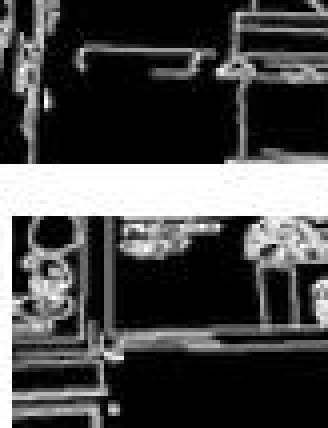
Patch B – mostly black with a vertical line on the left and an empty lower field. It contains no toy icons, so the left-edge contour (the cut-off mushroom) would not continue. It also shows a structural beam that actually appears below the hole in the main image, not inside it. → reject.
Patch A vs D – both contain the row of toy icons. This is the crucial clue.
-
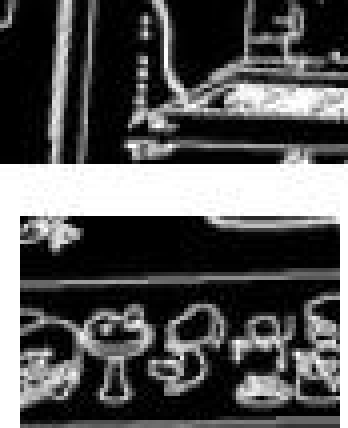
Patch A (bottom half of its image): shows, left to right: a partial round head, a full mushroom on a stem, a small duck-like figure, a round-headed figure, and a partial figure on the far right. The top of these icons sits about 1/3 down from the top of the patch, matching the y-position of the icons left of the blank (y ≈ 38–109 px into the patch). The horizontal line at the very top of Patch A aligns with the thin menu-board border seen just above the square.
-
Patch D (bottom half): also shows toy icons, but look at the spacing and shape: left to right it has five figures that are more uniformly spaced, with the second from left having a distinct circular head that does not match the cut-off shape on the left edge of the main image. More importantly, Patch D’s topmost white line is lower, and it contains a small vertical tick on the right side (visible in the enlarged image) that has no counterpart on the right edge of the blank in the main image. The contour continuity fails on the right side.
Compare left-edge continuity:
- In the main image, the shape touching the left border of the white square is the rightmost part of a mushroom stem (seen at x=393, y≈200). Patch A’s leftmost visible shape is exactly that partial mushroom stem, continuing seamlessly. Patch D’s leftmost shape is a full rounded head, which would create a double contour.
Compare bottom-edge:
- The main image shows a dark area below the square with a faint horizontal ledge at the very bottom of the hole. Patch A is predominantly black in its lower half, with only the icons occupying the upper portion — matching the expected dark gap. Patch D also is dark below, but its icons sit slightly higher, leaving an unnaturally large black margin that misaligns with the ledge.
Therefore, Patch A maintains continuous line flow:
- horizontal menu border → continues across top
- toy-icon row → extends naturally from left edge into the square
- right and bottom edges → stay black as in the original scene
Patch A is the only one that preserves the geometric structure without introducing new edges or breaking existing ones.
GT Response:
D