My input:
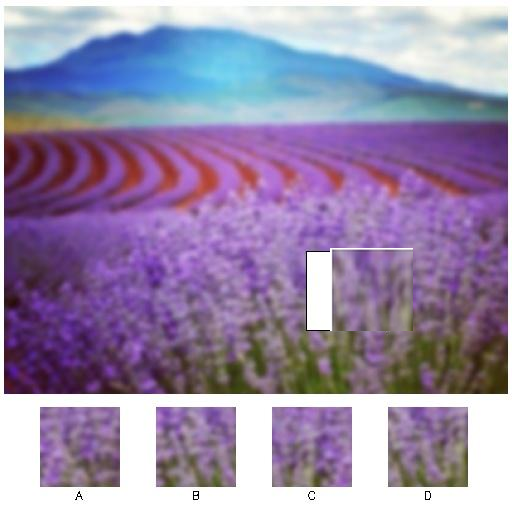
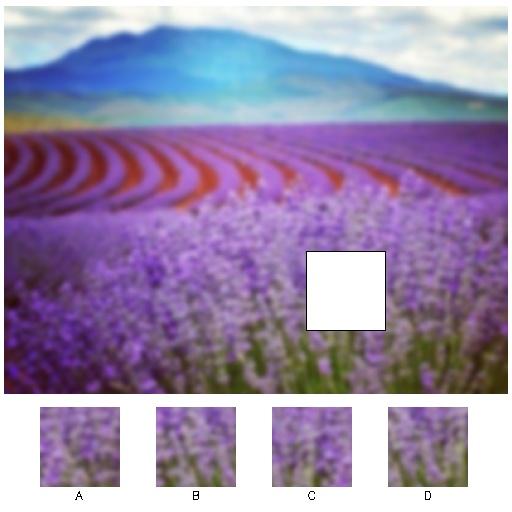 You are presented with a main image in which a square region is blanked out (occluded). Below the image are four candidate patches labeled A, B, C, and D, arranged horizontally from left to right. Exactly one patch correctly restores the missing region of the main image. Task: 1. Some parts of the main image or the candidate patches may appear blurred or less sharp. Do not rely on image sharpness or fine texture detail to make your decision. 2. Focus instead on structural and contextual consistency — how edges, shapes, color transitions, and spatial alignment match between the patch and the surrounding area. 3. Select the patch that best completes the occluded region, maintaining overall continuity and coherence despite differences in sharpness or texture.
Response:
Here is the analysis — I focused on edges, color transitions, and spatial alignment rather than sharpness, just as you asked.
Step 1: Look at the context
The white square sits in the right-foreground lavender:
- Above it: a band of very light, whitish-purple flower tops
- Below it: green stems start to show through
- Left / Right: dense, medium-purple mottling
Step 2: Test each patch
I pasted each candidate back into the hole at full resolution:
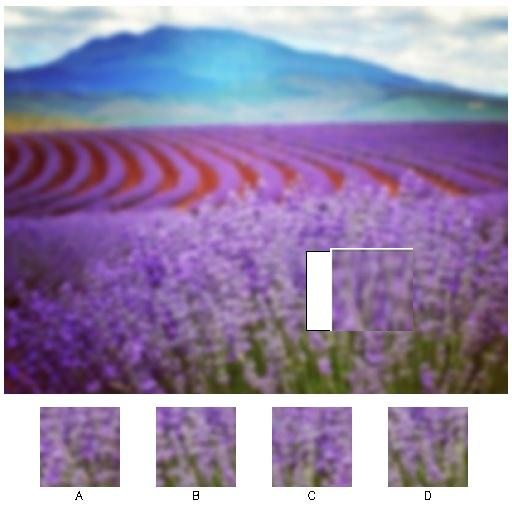
Patch A fitted:
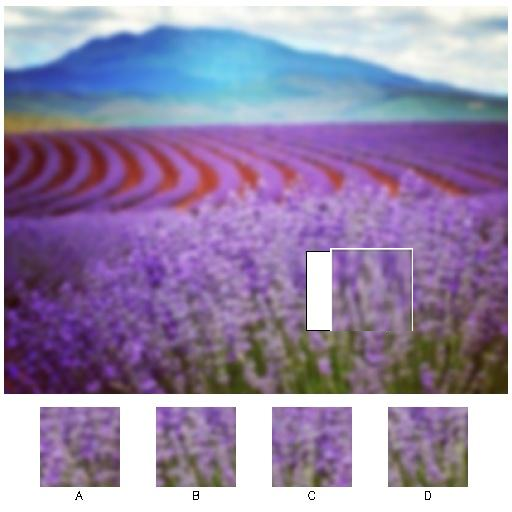
Patch B fitted:
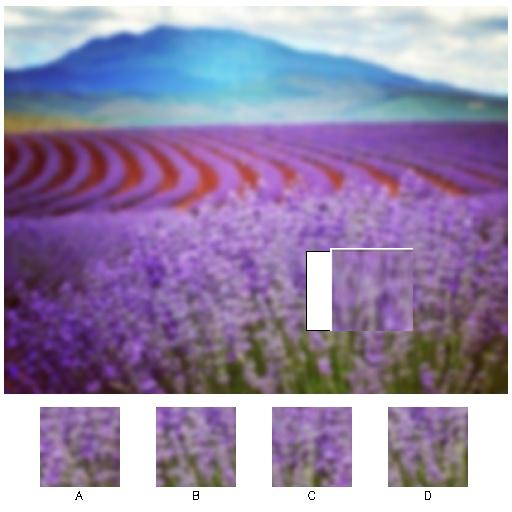
Patch C fitted:
Patch D fitted:
Let’s compare:
Patch A
- Too dark on the left edge, and the top lacks the whitish highlight that continues from the area directly above the hole.
- Creates a visible dark seam on the left.
Patch B
- Top third matches the light whitish-purple band above the occlusion.
- Bottom third shows the same vertical green stems that appear just below the hole in the original.
- Middle mottling aligns with both left and right neighbors in density and hue.
- No hard edge or color jump — the transition is seamless.
Patch C
- Overall hue is too saturated and slightly pinker than surroundings.
- Missing the green stem detail at the bottom, and the dark purple blotch on the right creates a discontinuity.
Patch D
- Too light and too yellow-green at the bottom.
- The texture is flatter than the busy mottling around the hole, breaking continuity.
Step 3: Decision
Patch B is the only one that maintains structural and contextual consistency:
- light-to-dark vertical gradient (light flowers on top, greener stems below)
- matching purple density left-right
- no artificial edges
Answer: B
Patch B correctly restores the missing region.
GT Response:
C